P*rn is slowly killing intimacy, connection and mens life span
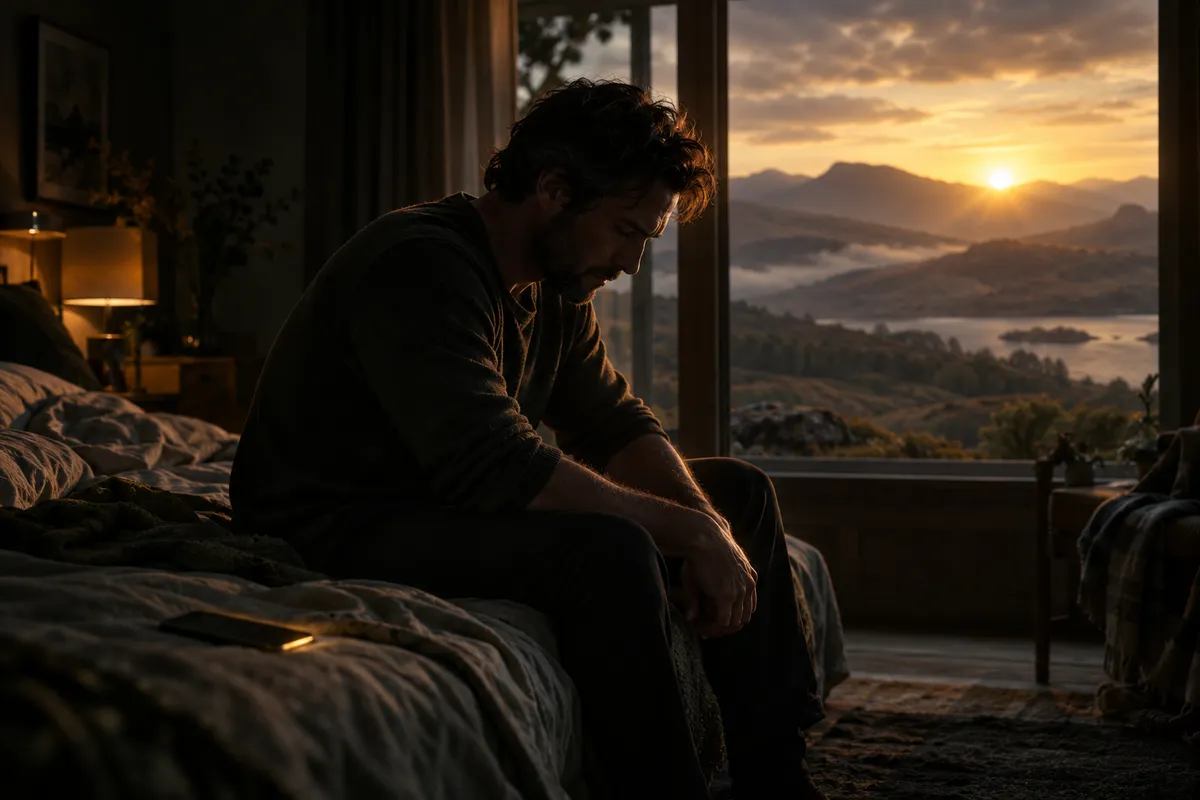
It's late.
The house is quiet. Everyone else is asleep.
You tell yourself you're just going to scroll for a minute. You know where this ends. You've been here a hundred times.
Twenty minutes later the screen goes dark and the feeling arrives. Not pleasure. Something heavier.
You clear the history. You put the phone face down. You promise yourself that was the last time.
And under the promise, a quieter voice says what it always says: what is wrong with you?
I know that voice. For years I did the same thing in private, for a quick release, just to feel better about myself for a minute.
So let me start where I wish someone had started with me.
Nothing is wrong with you. But something is happening to you, and it isn't what you think.
You're not addicted to p*rn. You're addicted to the few minutes when you don't feel unsafe.
And it's slowly killing three things: your intimacy, your connection, and your life span.
The hill I'll die on
I'll say it plainly, because colouring inside the lines isn't helping anyone rise.
You can't consume p*rn and be a fully healthy man. Not emotionally, not in your relationships, not sexually, not spiritually. After 20 years of this work, I haven't met the exception.
That isn't a judgement on you. It's a pattern I've watched play out, again and again, in men I've coached, men in circle, and in myself.
The men I've seen caught in it have far more in common than the habit:
They feel powerless in at least one area of life, usually more.
They're hiding something, and the hiding costs them more than the thing itself.
They aren't living their purpose.
They push their emotions down and chase a quick hit that never actually satisfies.
They're scared of real intimacy, and numb more often than they'd admit.
They carry shame, and a feeling of not being good enough, or of being too much.
And almost every time, there's a father who wasn't there, in body or in heart, and a mother who couldn't be emotionally available.
That last point is the whole story. Hold onto it.
What the research does and doesn't show
You'll hear people say "the science says p*rn is fine" and others say "p*rn rewires your brain". Neither is the whole truth.
Most of the Western research is correlational. It shows what tends to go together, not proof of what causes what. No study settles it one way. But the patterns are hard to ignore.
It starts before you choose it. In 2023 the Children's Commissioner for England surveyed 1,014 young people aged 16 to 21. The average age they first saw p*rn was 13. One in ten had seen it by nine. More than a quarter had seen it by eleven.
It shapes what you think sex is. 79% of those young people had seen sexual violence in p*rn before they turned 18. 47% said girls "expect" sex to involve physical aggression. They learned from what they were shown. Most of us did.
Your brain learns to chase the wanting, not the having. In 2014, researchers at the Max Planck Institute scanned 64 men. More hours of p*rn a week went with a smaller reward centre and a weaker link to the part of the brain that steers your choices. In 2017, a study of men seeking help for their p*rn use found their brains didn't react any differently to the images themselves. They lit up at the cue that an image was coming. It isn't the pleasure that has you. It's the moment before it.
It shows up at home. A 2017 review of 50 studies and around 50,000 people found that, for men, more p*rn went with lower sexual and relationship satisfaction. US research using national survey data found that married people who started watching p*rn were nearly twice as likely to be divorced by the next survey (6% rising to 11%).
It can become compulsive. The World Health Organization now lists Compulsive Sexual Behaviour Disorder as a diagnosis. A 2023 study of more than 82,000 adults across 42 countries found 4.8% at high risk, and that group watched p*rn more often.
And some of it is still emerging. You'll hear claims online about prolactin, the amygdala and dopamine: what happens in a man's brain after release, or in a woman's brain when she stops desiring her partner. Some of it rings true to what I see in my work. But the research is still in its infancy.
Correlational, yes. Harmless, no.
And the Eastern traditions have been saying this for thousands of years. Nine times out of ten, Western science eventually catches up.
Remember who profits, too. P*rn is a multi-billion-pound industry built on your attention. The platforms are designed to keep you scrolling. Nobody selling it has your marriage or your kids in mind.
P*rn is killing intimacy
P*rn is endless novelty. A new face, a new body, a new click, forever.
That trains something dangerous: the belief that aliveness comes from the next new thing. It's the same wiring that has men walk out of good relationships, chasing new attention instead of going deeper with the woman in front of them.
Most men aren't afraid of commitment. They're afraid of stillness. Because in the stillness, they'd have to feel.
And it comes home with you. P*rn teaches sex without presence. You have energy for her body, but not for her heart. When she reaches for emotional connection, you're nowhere to be found. When you reach for her physically, you're right there.
She stops feeling like a partner and starts feeling like a service.
You end up treating her the way you treat the screen: a fantasy to escape into, until real life goes off script. Then you pull away, she feels it, and the distance grows.
Desire at home doesn't come from a better technique. It comes from her feeling safe with you: your presence, your attention, the way you remember what she said last week, the way you hold her eyes without needing anything back.
Men notice the woman. Women notice the experience. The screen can never teach you that.
P*rn is killing connection
Here's what most men miss. P*rn rarely travels alone.
It sits alongside the overworking, the extra session at the gym, the scrolling, the Netflix, the drink, the vape, the next woman. Different doors, same room. Every one of them is a way to not feel what's underneath.
When something hits a nerve, you've got three choices:
Distraction: reach for whatever numbs it fastest.
Isolation: go quiet, pull away, handle it alone, the way you learned as a boy.
Transformation: turn towards it and feel it. That's the only one that changes anything.
The question that changes everything is simple: what am I distracting myself from feeling right now?
And shame keeps you stuck in the first two.
Researchers studying why some people feel "addicted" found it isn't only about how much they watch. It's also about moral incongruence: doing something that goes against what you believe in. The more you hate yourself for it, the more trapped you feel.
I call this the Shame Paradox. Sexual energy is one of the most powerful forces in you. Try to cage it with shame and it's like trying to hold a wild tiger with wooden sticks. It doesn't calm down. It fights harder to get out.
Urge, release, shame, promise, tension, urge. The shame isn't stopping the cycle. It's fuelling it.
Guilt says I did something bad. Shame says I am bad. And shame doesn't live in your head. It lives in your body: the pelvis, the belly, the face, the places you don't show anyone.
Shame hides. That's why the history gets cleared and the phone goes face down. And whatever you hide from her, you're hiding from yourself first.
P*rn is killing men's life span
The ancient Daoist masters talk about Jing: your essence, your life force, the fuel in the tank.
They teach that it's finite, and that every time a man spills it, he's spending his vitality. If he doesn't replenish it, he burns through his life force faster than he was ever meant to.
That's very different from a healthy sex life with a monogamous partner you love. That's connection, and connection nourishes. But constantly releasing, alone, to a screen, or spreading your seed all over the place, is something else.
I've watched it in my own life and in hundreds of brothers over the last 15 to 20 years. Their drive drops. Their fire drops. Their vitality drains away. And it was never about sex. It's compensation: a way to avoid feeling the pain underneath.
The West has tried to measure this. In 2003, a study of 28 men found their testosterone peaked on the seventh day of abstinence, at nearly one and a half times their normal level, before coming back down. That study was later retracted, not because of its method, but because the same work had already been published in a Chinese-language journal. Nobody has properly repeated it since. So the West is still arguing about it. The East settled it thousands of years ago.
What isn't up for debate is where disconnection leads. A review of 148 studies and more than 300,000 people found that people with strong relationships had a 50% higher likelihood of survival. In 2023, the US Surgeon General said loneliness is as deadly as smoking up to 15 cigarettes a day. And here in Scotland, in 2024, the suicide rate was nearly three times higher for men than for women.
P*rn feeds the hiding. The hiding feeds the isolation. And the isolation is killing men.
Where it really comes from: the mother and father wound
A man doesn't reach for p*rn because he's weak. He reaches for it because, somewhere, he learned he wasn't safe.
If you grew up with unregulated parents who couldn't attune to your emotional needs, you grew up searching. For connection. For safety. For someone to really see you. And early on, you found something that gave you that feeling, at least for a while: sex, and emotional intensity.
That's how hypersexuality is born. Not from too much desire. From too little safety.
It also became another arena to perform for love. The same way you learned to perform on the sports field, in the classroom, and in every room where you had to be the good boy (or the good girl) to be accepted.
The father wound teaches a boy he has to earn love. If Dad wasn't there, or only showed up when you won, you learned you're only enough when you're achieving. When the achieving stops, or the pressure gets too much, you need somewhere to put the feeling. P*rn asks nothing of you. No performance. No rejection.
The mother wound teaches a boy where comfort comes from. If Mum couldn't be emotionally available, you learned to soothe yourself, alone, in secret. The screen becomes the comfort you never had, without the risk of being turned away.
And it didn't start with you. The men in your line buried their pain in work, drink, silence and secrecy for generations. You're not fighting a moment. You're fighting a legacy. Which means you get to be the one who ends it.
That's what you're addicted to. Not the images. The few minutes of safety.
P*rn, OnlyFans, and the wound we share
Now the part some people won't like my opinion on, but I've never been one to pander to that!
So here is a hill I'll die on...
P*rn makes men weak.
Weak men make women feel unsafe.
Unsafe women turn to p*rn or OnlyFans.
No woman who feels secure in who she is, and has made peace with her mother and particularly her father wound, sells her body on OnlyFans. Convince me otherwise.
But hear what I'm actually saying, because this isn't condemnation. It's compassion.
The same wound that had me reaching for a quick release in private is the same wound behind a young woman selling her image to strangers. Both are looking for approval. Both are trying to feel wanted without the risk of being truly known. Give either of them five minutes to tell the truth about what they really want, and it's the same thing: to be loved, all of them, and to give their kids a better start than they had.
As a friend of mine said, these platforms only exist because men are buying. If we want women to feel safe, the change starts with us.
What to do the next time you're horny
Willpower alone keeps failing because you can't think your way out of something your body is holding. So work with the body.
The Daoist tradition has a beautiful way of seeing this: Jing, Qi and Shen, the three treasures. Potential, activation, illumination.
Jing is your raw essence, the fuel in the tank. Sexual energy at the base of the spine, waiting.
Qi is your life force, the fuel moving. Breath, movement and awareness circulate it.
Shen is spirit, consciousness and presence. It's what that energy becomes when it's illuminated: creativity, purpose, love.
The teaching holds that for a man, retaining and circulating that energy builds strength, while for a woman, release is more nourishing. Same energy, different expression.
So the next time the urge comes, instead of spending it, try this:
Pause and name it. Am I actually horny, or am I bored, stressed, lonely, or looking for validation? Most of the time it's one of those, and sexual attention is just the easiest button to press.
Don't shame the thought. You didn't create it. You're responsible for what you follow, not for what arrives. Let it pass without judgement and without following it.
Breathe it up. This is our Daily Soulful Breath. Draw the breath from the base of your spine up into your heart, and let it expand into your heart field, your torus field. Same energy, different direction.
Move it. Lift, run, train, build something. Give that fire somewhere to go.
Use it. Bring it into your work, your voice, your art, your goals. That's Shen: what are you channelling it into?
And then the bigger work:
Stop feeding the algorithm. Mute and unfollow whatever keeps you stimulated all day.
See women as whole people, co-creators in a life you're building, not stress relief.
Build a life you don't need to escape from. A man without purpose will distract himself with pleasure. Purpose, discipline, brotherhood and faith make cheap stimulation lose its grip.
Break the secrecy. Shame survives in hiding. One honest conversation with men who won't judge you does more than a hundred promises at 1am. Most men are still waiting for words they never got: I'm proud of you. I love you. In circle, men finally hear them.
Heal the wound underneath. The father wound and the mother wound don't heal through understanding them. They heal when the body finally feels safe enough to let them go.
The Embodied Man Clan meets every Saturday, 9 to 10.30am at Sparta Boxing Academy, Falkirk, and half of every ticket goes to the Scott Martin Foundation. If you're near, click this link to join us in circle, where you can finally put this down and be seen, heard and understood, with no judgement, guilt, shame or pressure.
The tiger was never the enemy
The tiger isn't bad. It's life force. It's the same energy that builds, creates, loves and protects. It's the energy that could make you the man your partner feels safe with, and the father your kids feel safe with.
Caged in shame, it fights you; met with honesty, in your body and in the company of men who get it, it becomes yours again.
The world has never been more hypersexual. That's exactly why the men who master this energy will be the ones who stand out and lead humanity back to the future of connectiona nd truth.
You don't need another promise at 1am.
You need somewhere to put it down.
I am here to help you anyway I can.
Thank you for reading this very taboo subject,
Mark.
P.S. I've also made a more in depth video on my YOUTUBE channel for you to enjoy
P.P.S. If you're not near Falkirk and you need support healing from p*rn addiction at the root, send me a DM on Instagram (@markreidhealing). Let's talk about getting your life force back, so you can feel present, connected and proud of the man in the mirror.
Sources
Children's Commissioner for England: "A lot of it is actually just abuse" (2023)
Max Planck Institute: Kühn & Gallinat, JAMA Psychiatry (2014)
Wright et al., Human Communication Research meta-analysis (2017)
Grubbs, Kraus & Perry, Journal of Behavioral Addictions (2019)
The 2003 abstinence and testosterone study, and its retraction
About Mark: Mark Reid is the founder of Trysted Soul. For 20 years he has helped people find purpose and love beyond trauma by healing the root mother and father wounds, with no new age BS or bypassing.


